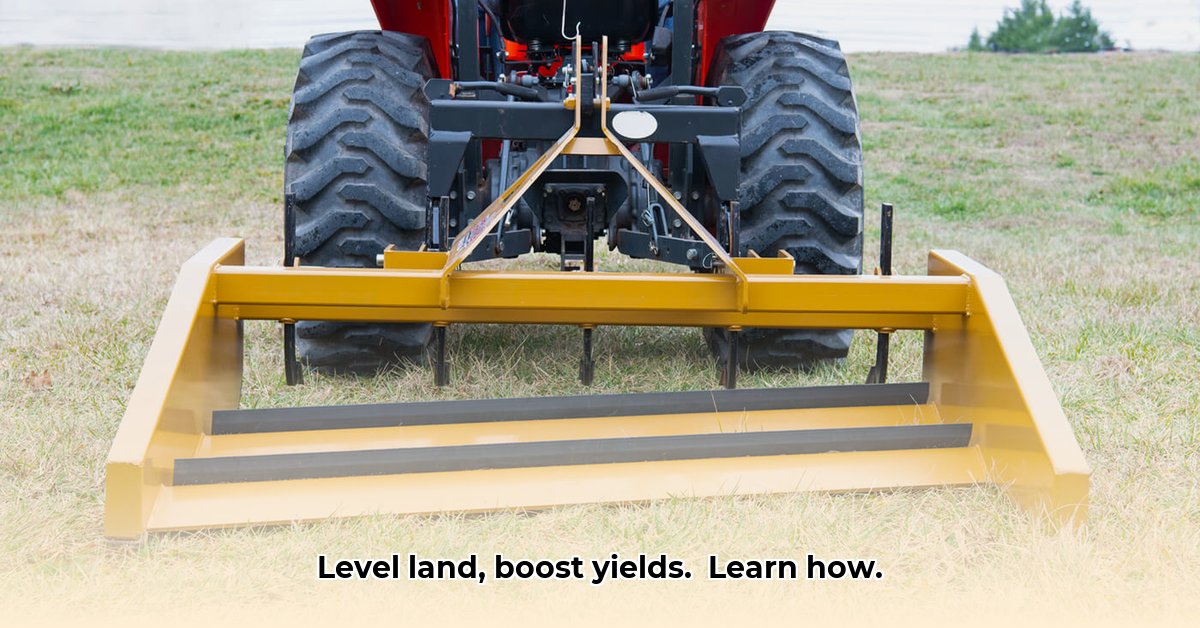
Leveling your land is crucial for efficient and sustainable farming. This guide provides actionable steps to select the right equipment, master leveling techniques, and understand the broader context of sustainable land management. Done correctly, land leveling significantly improves water usage, reduces erosion, and ultimately boosts your crop yields. For more information on farm tractors, see this helpful guide: Tractor Types.
Choosing the Right Tractor Leveler: Matching the Tool to the Job
Selecting the correct tractor leveler is paramount. Different tools are best suited for various tasks, much like choosing the right tool in any project. Let's examine the options:
Land Levelers (Precision Leveling): These attachments are designed for achieving incredibly smooth, even surfaces, ideal for efficient irrigation and planting. They are the best choice for achieving perfectly uniform fields.
Box Blades (Versatile All-Rounders): These are highly versatile attachments capable of handling leveling, minor soil redistribution, and initial tillage. They are a cost-effective solution for farms with diverse needs.
Scrapers (Heavy-Duty Movers): For moving large volumes of earth and significant terrain modifications, scrapers are the heavy lifters. They are suitable for large-scale grading projects but less precise than land levelers.
Selecting the right tool requires careful consideration of:
- Your soil type: Sandy soil requires different techniques than clay soil.
- The size of your operation: Small farms may only need a box blade, while large operations may require a scraper and a land leveler.
- Your budget: Renting equipment initially can allow for testing before investing.
Leveling Your Land: A Step-by-Step Guide
Efficient land leveling is paramount for sustainable farming practices. Here's a step-by-step guide:
Step 1: Site Assessment: Before starting, conduct a thorough site survey. Identify high and low points, natural drainage patterns, and your soil type. This assessment informs your planning and equipment selection.
Step 2: Equipment Selection: Choose your leveler based on your site assessment. For precise leveling, a land leveler is superior. A box blade offers more versatility for farms with multiple needs.
Step 3: Precision Techniques: Utilize GPS-guided leveling systems for enhanced accuracy and efficiency. While there's an initial cost, the long-term benefits significantly outweigh this investment, particularly regarding water conservation and uniform field conditions. Studies show that GPS-guided leveling can increase irrigation efficiency by up to 20%.
Step 4: Continuous Monitoring and Adjustment: Land leveling isn't a one-time task. Regular checks ensure the desired level is maintained, and any issues are addressed promptly. Regular monitoring can prevent significant problems developing over time.
Sustainable Land Management: A Collaborative Approach
Sustainable farming requires a concerted effort from various stakeholders. Efficient land management benefits all involved: farmers, consultants, manufacturers, and government agencies all play essential roles.
| Stakeholder | Immediate Actions | Long-Term Vision |
|---|---|---|
| Farmers/Landowners | Experiment with different leveling attachments. | Invest in precision technology, prioritizing long-term cost-effectiveness. |
| Consultants | Develop and disseminate best practices for various soil types. | Conduct ongoing research to improve sustainable land management techniques. |
| Manufacturers | Develop more fuel-efficient and environmentally friendly equipment. | Explore integrated AI systems for more efficient and precise leveling. |
| Government Agencies | Offer training programs and financial incentives. | Develop policies promoting efficient land use and responsible resource management. |
Cost-Effectiveness and Environmental Impact: A Balanced Approach
The choice of land leveler impacts both costs and environmental sustainability. Consider the following:
Cost Analysis: The initial purchase price is only a part of the overall cost. Remember to account for maintenance, fuel consumption, and operator skill levels. Experienced operators can significantly reduce time spent on leveling, leading to cost savings.
Environmental Assessment:
- Soil Compaction: Heavy attachments can compact soil, reducing water infiltration and aeration. Careful management practices are vital to mitigate this.
- Erosion: Improper leveling increases erosion risk. Contour plowing and other conservation techniques are crucial.
- Fuel Consumption: Efficient equipment and techniques reduce fuel use and emissions, contributing to a smaller carbon footprint.
Choosing the Right Equipment: A Practical Guide
Here’s a step-by-step guide to simplify the selection process:
- Thorough Land Assessment: Conduct a detailed field survey, noting slopes, soil type, and existing vegetation.
- Define Objectives: Clearly define your precision needs and budget constraints.
- Attachment Research: Review the pros and cons of each attachment type in relation to your needs.
- Obtain Multiple Quotes: Contact multiple suppliers for competitive pricing.
- Long-Term Cost Consideration: Factor in maintenance, fuel, and potential environmental costs.
By carefully weighing the cost, environmental impact, and your specific farm needs, you can create a sustainable and profitable operation. Remember, sustainable farming is a continuous journey of improvement.